- Oslagbara priser året om
- Fraktfritt på stora delar av sortimentet
- +46 (0)31-27 42 30
- info@streckkodscenter.se

Types of Labels – Paper vs Synthetic Labels Explained
Choosing between paper labels and synthetic labels affects durability, cost, print quality and performance in warehouse, shipping, retail and industrial labeling.
This guide explains the key differences between label materials and helps you choose the right label type for your business, printer and application.
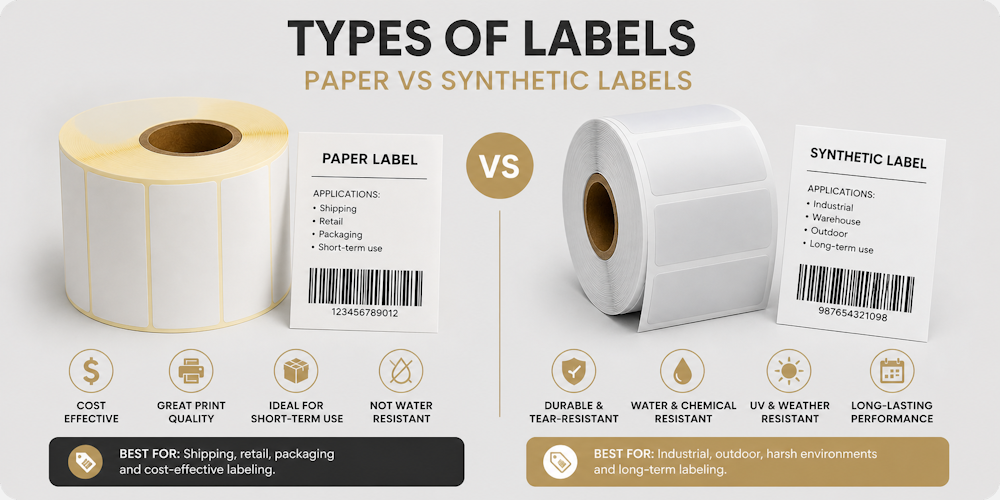
Quick answer: Paper labels are best for cost-effective short-term use. Synthetic labels are best when durability, moisture resistance and long-term readability are important.
What are paper labels?
Paper labels are the most common and cost-effective label material. They are widely used for shipping labels, product labels, retail pricing, packaging labels and internal logistics.
Paper labels are a strong choice when the label has a short or medium lifespan and does not need to withstand moisture, heavy handling or harsh environments.
Advantages of paper labels
- Low cost and widely available
- Good print quality for text and barcodes
- Ideal for shipping, retail and packaging
- Suitable for short-term and medium-term use
- Compatible with many label printers
Limitations of paper labels
- Limited resistance to water and moisture
- Can tear, scratch or wear over time
- Not ideal for outdoor use
- Less suitable for chemicals, abrasion and harsh handling
What are synthetic labels?
Synthetic labels are made from plastic-based materials such as polyester, polypropylene or polyethylene. They are designed for applications where labels need higher durability and longer life.
Synthetic labels are commonly used in warehouses, industrial environments, outdoor applications, cold storage, asset marking and situations where labels are exposed to moisture, chemicals or abrasion.
Advantages of synthetic labels
- Highly durable and tear-resistant
- Better resistance to water and moisture
- Suitable for outdoor and industrial use
- Good choice for long-term identification
- Can resist abrasion, handling and tough environments
Limitations of synthetic labels
- Higher cost than paper labels
- Requires the correct printer setup and material choice
- May require the right thermal transfer ribbon
- Not always necessary for simple short-term labels
Paper vs synthetic labels – key differences
- Cost: paper labels are usually cheaper
- Durability: synthetic labels last longer
- Moisture resistance: synthetic labels perform better
- Use case: paper is ideal for shipping, packaging and retail
- Environment: synthetic is better for industrial and outdoor use
- Lifespan: paper is best for short-term use, synthetic for long-term use
Barcode readability and scanning
The label material affects barcode quality and readability. Clear, durable labels help reduce scanning errors and work better with barcode scanners in warehouse, retail and logistics environments.
When to choose paper labels
Choose paper labels for shipping labels, packaging labels, retail price labels, address labels and internal labels where cost efficiency matters and the label does not need to survive harsh conditions.
When to choose synthetic labels
Choose synthetic labels when the label must resist moisture, tearing, chemicals, abrasion, outdoor exposure or long-term storage. They are often the safer choice for warehouse, industrial and demanding labeling applications.
Common mistakes when choosing label materials
A common mistake is choosing paper labels for environments where durability is required. Moisture, friction, cold, heat or outdoor exposure can quickly reduce label readability.
Another mistake is choosing synthetic labels when a simple paper label would be enough. The best label material should match the label lifespan, environment and total cost requirements.
FAQ – Paper vs synthetic labels
Are paper labels good for shipping?
Yes, paper labels are often a good choice for shipping because they are cost-effective and usually only need to last during transport.
Are synthetic labels waterproof?
Many synthetic labels have strong moisture resistance and are a better choice than paper labels for wet or demanding environments.
Which label material is best?
Paper labels are best for cost-effective short-term use. Synthetic labels are best when durability, resistance and long-term readability are critical.
Need help choosing the right label material?
Explore our labels or contact Streckkods-Center for advice.
Email: info@streckkodscenter.se
Phone: +46 (0)31-27 42 30